CS
Christian Servin
Professor of Computer Science at El Paso Community College. Computing education, fuzzy logic, cybersecurity and AI.
15years at EPCC
80+publications
2Springer books
10+Springer chapters
Dr. Christian Servin has served El Paso Community College for 15 years. He teaches computing courses, develops best practices in computing education, and builds academic and research partnerships with school districts and four-year colleges.
A computer scientist by training, he earned his Ph.D. in Computational Science at The University of Texas at El Paso. His research covers cybersecurity, artificial intelligence and computer science education, alongside foundational work in fuzzy logic and interval computations.
He has developed several open educational resources for computer science, including The CS OER funded through the THECB OERTX program, and is Principal Investigator of Hack the Border, a binational adversarial series for the border region. In 2019 he was selected for the INSPIRE CS–AI fellowship for CS teacher educators, led by the MIT Teaching Systems Lab and Carnegie Mellon University.
He has more than 80 publications in journals and refereed conference proceedings, including a textbook, two Springer books and more than ten Springer book chapters.
Brings a cybersecurity lens into the first programming courses, so students learn red-team and blue-team strategies early, and tests how well these practices work alongside software engineering principles. Supported by the NSF project Developing Computational Adversarial Thinking (Award #2300378). Course modules and research at the Adversarial CS Project.
Looks for tools and libraries that bring justice, equity, diversity and inclusion into machine learning decisions in problems such as social media, autonomous vehicles and misinformation, and examines the ethical responsibilities in building them. More at the Affinity Research Group: xAI Institute.
More than $1.3 million awarded across 13 grants and contracts as PI or Co-PI.
National and international curriculum recommendations shaped through ACM, the ACM Committee for Computing Education in Community Colleges (CCECC), IEEE-CS, AAAI and the Computing Research Association.
Accreditation: ABET program evaluator (CSAB, Cybersecurity) since 2019; CSAB/CAC Criteria Committee, General Criteria and Cybersecurity Associates Taskforces since 2022; ABET Two-Year Core Curriculum Team since 2019.
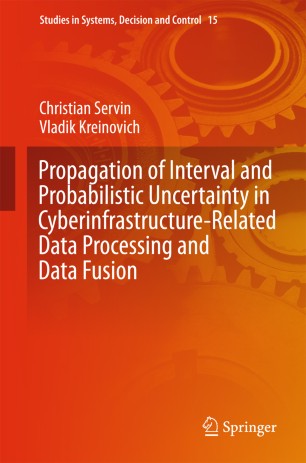
Drawing on examples from the geosciences and environmental sciences, the book shows how to describe uncertainty properly, justify and speed up algorithms for processing it, and extend uncertainty propagation to a three-component error model.
View on Springer
Aligned with the ACM/IEEE-CS/AAAI CS2023 curricular guidelines, the workbook supports individual and collaborative learning through Java, decision structures, loops, methods, object-oriented programming, recursion and data structures.
View on CognellaAlso with Springer: What to Teach, How to Teach, Why Some Ideas Work and Some Don't: In All This, Modern Analytics Can Help (C. Servin, O. Kosheleva and V. Kreinovich, in press). Editor of the NAFIPS 2026 proceedings, Soft Computing, Fuzzy Systems, and Explainable AI, and of the SIGITE 2024 proceedings.
Open educational resources: The CS OER · Secure Scripting · The CS init()
Students, colleagues and partners interested in research, curriculum or community college pathways are welcome to reach out.